Monday, May 14, 2018

On The Quality of Frostburg State’s Dorms


On The Quality of Frostburg State’s Dorms

By William Everett, Elijah Lynch, Rainier Ramos

Frostburg (MD)

( 1,550 words, 5 interviewees)


Frostburg – On February 17th, 2018, residents of Westminster all were forced out of their warm beds and into a howling blizzard as the fire alarm sounded off once again.  Many of the disgruntled students crowded into the dining hall entrance just down the road to take shelter from the battering snow and cold wind.


Firefighters drive through the snow en route to Westminster
Packed into the Outtakes store, the students complained about being left out in the cold, in more ways than one. The fire alarm sounds in Westminster Hall so often, one would think that the dorm is home to arsonists in the making. However, the cause of these frequent alarms does not lie with the students.


Some wild stories may claim that the fire department comes to Westminster so often because of students using a certain herb. However, in most cases, when the alarm sounds off and white lights flash throughout the hall, it is because of excess smoke from one of the kitchens.


In Westminster, the kitchens are old, operating on dated equipment that often leads to accidents, such as excessive smoke from the stovetop heating up much more than the user intended. Sometimes students have to move from one kitchen to another in search of equipment that actually works. For example, sometimes the stovetops don’t heat up at all. And some of the ovens aren’t even usable because their racks are missing.

Good luck making a pizza without a rack
(Hayden Grossman, resident of Westminster Hall)

While Westminster residents are sometimes forced out of their dorm due to faulty kitchen equipment, it is not the only problem they face. For example, their laundry machines, washers and dryers, are notorious for their unreliability.


Some washers are known to the rumble and shake around the floor, moving around while in operation. Some of them leak out water. And the ones that do work often have an inconsistent timer, taking longer to wash clothes than what it says it will take.


As for the dryers, they have been known to leave burn marks and holes in clothing unless the temperature the heat is set to a low setting.  On top of that, some dryers fail to produce any heat at all.


Some students discover this for themselves when they leave their clothes in one of these machines for an hour, only to discover that they are still wet and they have to lug their heavy clothes to a different, working dryer on another floor.


Lastly, as a dorm with six floors, the elevators are arguably the most important machines in the dorm for students who don’t want to hike up a flight of stairs after a long day of classes. Unfortunately, these, too, are not entirely reliable. 


The elevators sometimes open their doors randomly, with no one pressing the button to summon them. Sometimes they fail to work, which is especially problematic for anyone carrying heavy boxes. In fact, the safety certificates in the elevators are outdated.

The Safety Certificate in Westminster’s right-hand elevator


The “Valid Until” date reads March 2nd of 2018


While Westminster Hall has its problems, it is far from being the only dorm at Frostburg State in need of attention. Most residence halls, if not all of them, have certain problems that their occupants have to deal with.
Olivia Berge, an RA for both Simpson Hall and Frost Hall, reveals some of the issues with both of these dorms. She says that the appliances in both halls “are not as good as they could be.” The ovens in these halls seem to never work properly, as they either produce too much or too little heat, which results in food being cooked unevenly.
Additionally, Oliva says that the washers and dryers are “constantly breaking.” The dryers in Frost Hall, in particular, produce so much heat that they will singe clothes inside of them. Lastly, the shower heads and curtains in these halls are outdated and in need of attention.
There is also a notable lack of air conditoning in every freshman dorm other than Frost Hall. Freshman who enroll at Frostburg State are required to live on campus for at least one year, and this is being extended to two years for the class of 2023 and beyond.
As summer tends to gets hotter with each passing year, every freshmen living in these dorms may find themselves feeling even more uncomfortable than the last students to live in their rooms. Rainier Ramos, who once lived in Gray Hall, said, “I remember being extremely hot and sweaty in my dorm in Gray Hall since they have air fans, not air conditioners.”
This chart displays the high temperature at Frostburg on September 1st for the past six years. It ranges from 75°F to 86°F
(This information was provided by usclimatedata.com)
The only housing with air conditioning that freshmen can opt for is Edgewood Commons, which is not an option for everyone as it is both expensive and rather distant from the university’s academic buildings.

Even in the newest residence hall, Cambridge, there are a few issues. Most notably, there is only one washer and dryer on each floor. This means that, on each floor, these lone machines must be shared by twenty four to even forty eight different people.
Additionally, Jason Weatherly, a Frostburg Alumni, had a few things to say about Westminster Hall. “I never used the kitchen, but I always heard that they were having major issues.” He also says that there were “situations when I would be sleeping at 12:30 in the morning and there would be random fire drills.”
Lastly, Patrick Pruitt, an off-campus student, says that dorm life “wasn’t for me.” He elaborates by saying, “if they took a little bit more care of the appliances and the elevators then people would actually care more for the dorms.”
So, why are the appliances in Frostburg’s dorms so lacking? Arguably, the low quality of all these appliances is contributing to the declining number of students enrolling at Frostburg State. In an attempt to attract more students, the university has decided to build a new (currently unnamed)residence hall in the lower quad of campus.
Construction of this hall is set to begin in summer of 2018 and finish by 2020. This new dorm will have 125,000 square feet of space, 431 new beds, and modern amenities. While this new dorm sounds very nice, it begs the question: what about the other dorms? One might assume that the university, particularly the Residence Life Office, may try to sweep these issues under the rug.
However, an interview with Sean McNalley, Associate Director of Residence Life, sheds some light on this issue.
Although one might think that the Residence Life Office controls everything related to the residence halls, Sean McNalley says that RLO actually acts as a “middle role” between the students and the people who fix the appliances. RLO’s primary purpose is to help pair like-minded students together as roommates to “create a safe learning environment,” rather than oversee the dorms themselves.
However, they are not entirely uninvolved. When a student files a complaint, either directly to RLO or to an RA, RLO reports the problem to the company that makes the appliances, who then step in to solve the problem.
Rather than addressing the problems themselves, RLO is limited to this position while advocating for improvements and renovations to the dorm. So when it comes to faulty laundry machines and missing oven racks, RLO is not to blame.
McNalley says, “We do listen to student feedback,” and he wishes that Residence Life could solve all the problems in the dorms. He emphasizes that RLO can advocate for improvements, but does not have direct control over the dorms.

On November 19th, 2017, Frostburg State’s president,On November 19th, 2017, Frostburg State’s president, Ronald Nowaczyk, shared an email with Frostburg's students that explains these budget cuts.

Revenues of that year were “less than expected,” so the university has kept new hires to a minimum and has taken actions to reduce travel costs for school staff. He also explained that funding for new buildings on campus was provided by the state of Maryland, rather than the university itself.

Fortunately, RLO’s advocacy has not fallen on deaf ears. Currently, Cumberland and Annapolis Hall are closed as they are receiving renovations. This is part of a “campus master plan,” according to McNalley, which aims to improve the quality of life in Frostburg’s residence halls over the course of five years.

Once renovations in Cumberland and Annapolis are complete, which is expected to happen in the 2018-2019 school year, the university plans to renovate Frederick and Westminster, though only one at a time. These renovations will include replacing roofs windows, and “mechanical systems,” as well as updating the dorm’s lighting and other electrical parts in the halls.

This could mean that elevators, laundry machines, and kitchen appliances will be repaired and/or replaced by newer, more reliable models. However, the exact details of these renovations are currently unknown. Additionally, it is not known if halls other than the ones in the lower quad (the freshman dorms in the upper quad) will be receiving renovations after Frederick and Westminster.

For more information, please see the following links:

Information on the new residence hall

Information on the Residence Life Office

Information on housing options at FSU


Trees, Bees, and Sustainability


Trees, Bees, and Sustainability
By:
Mason Weatherholt
Kaitlynn Hamby
Dray Sumpter
Daniel Gelso
Photo by: Mason Weatherholt. This is a photograph of a mini rain garden on the West Side Terrace of CCIT.

Sustainability is typically thought of in a political sense; a term used by politicians to lure citizens into believing that positive and genuine efforts are being made to maintain the environment and our use of its resources. According to Global Footprints, there is no universally agreed upon definition of sustainability. However, there are many different views on what it is and how it can be achieved. The original definition of sustainability development is, “development that meets the needs of the present without compromising the ability of future generations to meet their own needs” In layman’s terms, sustainability is basically the addition of new resources for every absorption of another resource. Meaning, that anything we use or take, we give back to where it originated. For instance, we cut down a tree in a vacant lot to build a new building, when that new building is erected, we plant multiple trees all around it. Seems simple now, right? Well not exactly, there is a lot more to it than that. The concepts behind modern day “sustainability” existed long before the term was coined. Originally, there were six relatively separate guiding ideas before the term “sustainability” was used, “ecological/carrying capacity root, resources/environment root, biosphere root, critique of technology root, ‘no growth’/‘slow growth’ root, and the ecodevelopment root” (Kidd).

            According to Kidd, the first time the term “sustainability” was used in reference to the future of mankind was in 1972 in the book Blueprint for Survival. In 1972, “normative concepts” concerning sustainability were popular, and this was still the case in 1974, when the term was used in the United States as a justification for a “no growth” economy. Sustainability is usually used and thought of in a political sense, but it has a purpose in development as well.  It is becoming more and more common to construct buildings so that they are more environmentally friendly. For example, Frostburg State University has two buildings that are LEED certified.

Sustainability as it pertains to our college institution is basically multiple efforts to continue to receive funding by completing several different environmental programs. They seek to acquire a certain amount of funding from the state and local governments for their efforts to be ‘green’ and help the local environment. So essentially, every tree that they plant, every rain garden they build, and any other efforts made such as recycling, composting or proper waste management, will gain them more funding to better support those programs. Which, if you think about it, is truly amazing. They can start these programs and expand them until they literally pay for themselves. Which begs the question, why don’t all institutions practice sustainability on a larger scale?
Photo by: Mason Weatherholt. This is a photo of another rain garden located on the roof of Frostburg State University's Gira Center, as well as a photo of the draining system that collects the rainwater for the rain gardens.

            Well, actually, the popularity of sustainability is increasing, which is fantastic for our environment. More and more campuses across the nation are adopting these practices and more local governments are creating programs for increased funding to help support sustainability. All of this is great, but “will it actually make a difference?” is what most people beg to inquire. While that may be an important question to ask, the primary focus should be that any progress is progress and if all institutions and governments adopt these sustainability practices, eventually we can slow the rate of climate change and deforestation on a massive scale. That should be our goal, on the larger scale, not whether or not it makes a difference right here and right now.
Photo by: Mason Weatherholt. LEED Gold Certification for the Construction of CCIT in 2014-2015 (Located in the main hall of CCIT).

In recent years, Frostburg State University has been making great strides in their efforts to be a green and environmentally sustainable campus. Paper straws instead of plastic straws are available for use in the dining hall, newer buildings are constructed in compliance with sustainability standards, and there are several rain gardens on campus, for example. According to Rain Garden Network, rain gardens are, “a shallow depression that is planted with deep-rooted native plants and grasses. The garden should be positioned near a runoff source like a downspout, driveway or sump pump to capture rainwater runoff and stop the water from reaching the sewer system”. FSU has more than three rain gardens on campus. They also have at least seven different sustainability program categories on campus: Building Operation and Maintenance, Design and Construction of new buildings, the purchase of cleaning products, the purchasing of office paper, LED Exit signs, lighting in the Performing Arts Center, and occupancy sensors in some buildings on campus. FSU also has a sustainability minor, composts, recycles, and is a member of Tree Campus USA. 
Photo by: Mason Weatherholt. This is one of the larger rain gardens located in front of CCIT. This is where all the drains that collect rainwater empty out.

Tree Campus USA is a program that was created by the Arbor Day Foundation in 2008 and sponsored by Toyota with the intention of, “honoring colleges and universities and their leaders for promoting healthy trees and engaging students and staff in the spirit of conservation”.  In order to gain the title of “Tree Campus,” FSU had to follow Tree Campus USA’s five standards: maintaining a tree advisory committee, a campus tree-care plan, dedicated yearly expenses for the campus tree program, an Arbor Day observance, as well as a student service learning project. Trees planted on campus as part of this program are trees native to the area, although they are less common types. FSU’s tree advisory committee prefers less well-known tree species because some of the more well-known species get diseases easily. They purchase the trees from local tree nurseries. 

FSU was first awarded the title of Tree Campus USA in 2012 and has maintained the title every year since then. In 2016, FSU students approved a Sustainability Fee application so 16 native trees could be purchased and planted in replacement of white ash trees on campus that died from infestation of invasive pests. This replacement of dead trees helped FSU to maintain the title in 2016. FSU also works with Tree City USA on volunteer projects in Frostburg, and FSU will become a bee campus soon, as well. Dr. Sunshine Brosi will be part of Bee and Tree Campus for FSU. FSU is not only a Tree Campus though. FSU also composts food scraps, and some dining services even donate leftover food to the local food bank. 
Photo by: Mason Weatherholt. This is a photograph of more of the rain garden in front of CCIT as well as the trees, bushes, and plants in the garden.

FSU has its own composting machine, and composts food from the dining hall that is left uneaten after meals, as well as food that is left on plates returned to the kitchen. The pre-production, such as rinds from melons, and the leftover scraps are separately cut down into a pulp, and then combined in the composting machine. The machine can hold about 25 gallons of food pulp and the entire process, from input to output, takes about two weeks. This means that about every two weeks, 25 gallons of food is composted. There are about 52 weeks in a year, so 26 weeks of composting 25 gallons of food pulp means approximately 650 gallons of food is composted every year, and this program was implemented at FSU about four years ago. The program is still relatively new, but already pretty successful. However, the system isn’t perfect yet, so there is still waste on campus that needs to be properly disposed of, unfortunately.

Graph by: Mason Weatherholt
The Safety Office within the Office of Human Resources put an outline of procedures regarding the disposal of waste into action through a series of laws and regulations dictating how waste is disposed of. The steps taken in order to rid the environment of toxic waste begins with preliminary measures. Due to the rising national concern about the waste chemicals being dumped without concern of the consequences, the Office of Human Resources Safety Office controls how the hazardous waste from FSU’s campus is disposed of. The page specifically mentions that, in the majority of circumstances, chemicals and chemical products are not to be poured down the drain or discarded in the trash. There is a designated area where chemical products are to be disposed of with needed information regarding proper disposal provided. For example, certain chemicals should not be mixed together: non-chlorinated solvents, flammables, and oxidizers.  

The chemical waste is picked up every 90 days, and if needed, there are emergency pickups for life threatening situations. The waste containers are labeled with when the waste was placed in the container. This is relevant because, as the website states, “it is essential that an accurate, up-to-date inventory be maintained of chemical contents.” There is also a waste minimization program enforced under the Resource Conservation and Recovery Act (RCRA) that provides strict guidelines concerning the process of waste being created, separated, and later disposed of. Specifically, waste paints and solvents are potentially hazardous to the environment.  

A person disposing of paint has to first determine if the paint is latex or oil-based. If the paint includes latex, the paint is not a threat to the environment or ground water systems. Latex paints are allowed to be placed into standard waste disposal containers. The paint containers are allowed to be disposed of when almost all of the paint is emptied from the can and the remaining paint sticking to the container is completely dried out. Oil-based paints and solvents are a threat to the environment and water systems, so they must be disposed of through the Office of Human Resources Safety Office. The more dangerous solvents, “turpentine, turpex, xylene, toluene, mineral spirits and like products should be collected in a bulk container…to minimize disposal cost.” The area where the containers are disposed of should be a, “well-ventilated area, free from open flame, heat and sparks.” 

Tuesday, May 8, 2018

Feature Story - Inside WFWM Radio and Radio as a Mass Medium


Inside WFWM Radio and Radio as a Mass Medium
By Rainier Ramos
Frostburg, MD, May 1st, 2018
Located on the third floor of the Center for Communications and Information Technology is Frostburg State University’s Radio Station, 91.9 WFWM. WFWM is a public radio station that is an affiliate of NPR (National Public Radio).
Many of the new generations of mankind retrieve their “daily scoop” of information from electronic applications such as Snapchat, Instagram, Twitter, etc. But, electronic applications such as the ones mentioned cover topics on the national and global scale for the most part. WFWM works to serve the public, providing them with local information along with quality radio programming for the local area.
“We (WFWM) have multiple missions, but in the grand scheme of things it comes down to supporting the communities. Supporting the local community, supporting the campus community, supporting the student community”, said Chuck Dicken, Station Director and Program Manager at WFWM.
The station was first created in 1984 when it became an FM station, it existed prior but did not have the WFWM call letters. At first, the station was a carrier current station which meant that the signal was carried through the electric systems in the building where headquarters was located.
Towards the end of 1984, the call letters of WFWM were given to the station. WFWM as an FM station started in May of 1988. The station used to be on a different frequency in its earlier days; 91.7 exactly.
“We were also on a different frequency back then, it was 91.7 and sometime around ’96, somewhere in that time frame we got a power boost in our transmitter signal and as a result we had to move to 91.9”, Dicken explained.
Staffing for the radio station consists of two paid staff members, Chuck Dicken and Jeff Rosedale, about 12 volunteers, with an advisory board of seven people. Jeff Rosedale is the station’s music director, and supervises XFSR, the student-run radio station. WFWM’s advisory board consists of members from both the University and local community, serving to provide advice on how the station should function.
There are a variety of formats that WFWM uses during their broadcast. Roots music, Americana, bluegrass, early country music, Keltic folk music, traditional music, swing era jazz are many of the genres that the station plays.
The reason for WFWM’s format choices is that they are supplying the local area with music that aren’t provided by the commercial stations. In commercial radio, stations must play what the people want to maintain stability.
“They’re not gonna be able to play classical around here and make money off of it and continue. They’re not gonna play jazz because there’s not as many people listening to that as listening to contemporary country music for instance. But we can, because our mission isn’t to make money our mission is to play quality music that isn’t available elsewhere”, Dicken explained.
Station Director and Program Manager Chuck Dicken has been working with WFWM longer than any other staff member at the station. Dicken became an employee in 1998, making May 2018 his 20th anniversary. But, Dicken has been involved with the station since October of 1990.
Before working for the station, Dicken volunteered as both a student and community volunteer eight years prior to receiving a subordinate position. Dicken has since then moved his way up from a student volunteer, all the way to the top as Station Director and Program Manager.
Graduating with a degree in history, Dicken found that his love for music inspired him to work in radio. Dicken describes himself as a “music fanatic”, and he is highly interested in news. Public radio specifically caught Dicken’s interest since he was able to play the music he wanted to do on a community radio station.
“I got into radio because of my love for music, but I got on a community radio station because they were the ones that would let me come on and play the music I wanted to do. But also, because it’s public radio it’s literally there not to make a profit for anybody, but to provide quality music and entertainment”, Dicken said.
Jeff Rosedale, Music Director at WFWM, also has a heavy interest in music as equally as Dicken. Rosedale volunteered in the station as a student in 2000, and was then offered a job as a contractual employee in 2002. Rosedale has now been a full-time, state employee for almost 10 years.
Radio fascinated Rosedale early growing up, it was his connection to what was going on outside of his local area. Rosedale sought out to find new music and genres by performing a trick that he had heard to get distant stations.
“When I was young, I heard that you could take your television cable and connect it to your FM receiver so you could get stations further away. I spliced my parents TV cable, ran one up to my bedroom, and connected it to my TV. I was getting stations in the DC area that I had never had access to before, a whole new world of music, like totally different”, Rosedale explained.
Being able to be constantly surrounded by the world of music, music enthusiasts Chuck Dicken and Jeff Rosedale love their jobs.
 Dicken very much enjoys doing on-air shows, putting on concerts in the community, and generally working with the community. For the past 28 years, Dicken has been working with WFWM developing connections and proudly serving the public.
“The people that I work with, the people I’ve gotten to know over the years, the personal relationships you develop, that’s a big part of it as well in the sense that you’ve accomplished something, that there’s a lot of respect for the radio station and what we do in the community”, Dicken said.
Rosedale, who oversees the student radio XFSR, enjoys being able to get to work with younger people. Originally, Rosedale was on his path to becoming a teacher in college but went into radio instead. Rosedale still has a passion to educate and inform students with his knowledge, especially enjoying being around those who seek intelligence. Rosedale has found that he hasn’t had to seek music anymore, music is constantly coming to him because it’s part of his job.
“Being at a University you’re with people who are looking for intelligence. They’re looking for knowledge, they’re looking to get smarter and I’m all about that”, Rosedale said.
Rosedale is the host of “Radio Rosedale”, a two-hour show playing hits from the world of independent alternative rock. You can tune into Rosedale’s show on Thursdays from 10 p.m. to midnight.
Radio as a mass medium has changed dramatically as time has passed. Live performance used to be the only way that music and programs could be aired on the radio in its early stages. For example, if music was playing on the station the musicians were in the studio playing it. The introduction of Television as a mass medium impacted radio as talent on the radio transferred to television.
With television “stealing the show”, Rock and Roll became the savior of radio. Radio appealed to the younger demographic with rock and roll, which prevented it from dying out.
FM has become more dominant since music quality is better through it, but AM consists of news talks and sports because voice sounds better through it.
Technology has had a significant impact on staffing in the radio industry, automation systems specifically. Automation systems have decreased the number of jobs in radio since there is not a need for someone to be in a station to actually play something.
“As a result (of automation) you have less people that are involved in radio, and you have less people coming up from the ranks that know how to do it which is so vital for us teaching students how to do radio because they can be the next generation of people that come up behind me”, Dicken explained.

Digital services have been emerging increasingly such as streaming and electronic forms. Music is now easier than ever to find, and services such as YouTube, Spotify, Apple have been extremely successful.
According to variety.com, “traditional radio has failed to engage with Generation Z – people born after 1995 – and that its influence and relevance will continue to be subsumed by digital services unless it upgrades.”
As more generations are created, consumption of traditional radio gets lower in each generation which impacts its chances of being able to keep up with other mediums.
Some have said that radio is in a large decline, but Dr. Sheri Whalen, a Mass Communications Professor at Frostburg State University has said otherwise.
“Terrestrial Radio isn’t as much in decline as some have forecasted it to be. In some ways it has declined, a decrease in AM/FM. Still really important, it will play a role. The strongest will survive if they can adapt to online extensions”, Whalen explained.
Even though traditional radio seems as if there is no way for it to grow, it still has a chance by transferring to digital platforms. Rosedale used a pie analogy to illustrate how radio has changed over time. The “piece of the pie” refers to radio as a medium.
“Piece of the pie is a little smaller but there’s still a piece”, said Rosedale.
Dr. Jennifer Browne, English Professor at Frostburg State University and WFWM Advisory Board member has predicted that traditional radio is soon to be on its way out.
“Traditional radio is probably dying. Most people are probably getting audio through streaming online. Radio doesn’t maintain a serial narrative like podcasts do. It’s probably on its way out, like cable television”, Browne said.
Even though Browne believes radio is on the decline, she is an avid radio listener. Every day Browne is woken up by her radio alarm clack that is tuned to 91.9 WFWM. She even listens to the radio during dinner as its much a part of her daily life.
Browne has noticed that there is a huge vibrancy of radio stations as she drives through major cities on her way to Tennessee. Also, Browne has noticed that the Conservative and religious broadcasts are still booming when she visits Tennessee.
Dr. John Lombardi, Mass Communications Professor at Frostburg State University voiced his input on radio as a mass medium.
“Unfortunately, it’s (radio) undervalued. Seems to me that more and more people are losing sight of the value of local radio, it keeps the local community tied together”, Lombardi said.
According to Lombardi, on demand content is what consumers are attracted to the most. Young people such as millennials feel better off on electronic platforms since they have access to a data base to practically any song they want to find.
“Consumers want much more on demand content, radio isn’t designed for on demand”, Lombardi explained.
Also, Lombardi said that radio has become “more recorded…losing its localness”. Traditional radio has become more centralized airing pre-recorded broadcasts that are aimed to be on multiple stations around the country.
Radio has not been as big of a deal as other mass mediums, but still it does serve a major role in national emergencies. If an area is devastated by a natural disaster, radio stations are much easier to get back on air versus visual sources.
In national crises or disasters, radio can provide people with the information that they need about an event without visually presenting it to them. For example, news footage of 9/11 was very disturbing as the planes could be seen crashing into the building along with people jumping out of the burning buildings. Some of the images shown on the news were overwhelming, so radio served to provide facts without repeatedly viewing the horrendous events that unfolded.
There is still a chance for traditional radio to survive as long as it transfers to the online platforms that have been dominating mass media. Newspaper companies have transferred to online platforms and have rendered successful, showing there is a chance for survival.


Photo: Chuck Dicken – retrieved from http://www.times-news.com/dicken-named-new-station-director-at-fsu-s-wfwm/article_4dc53b35-e6c4-517b-b68d-64d8e5023965.html

Photo: WFWM 91.9 Station – retrieved from https://www.frostburg.edu/student-life/wfwm-.php


Focus Frostburg Assignment - The West MD STEM Festival


The Western Maryland STEM Festival

By Rainier Ramos

Frostburg (M.D.) May 5th, 2018
FROSTBURG – On Saturday May 5th, Frostburg State University hosted its annual Western Maryland STEM Festival. The event ran from 10 a.m. to 2 p.m. in FSU’s Physical Education Center Arena.
STEM stands for science, technology, engineering and math.
A large variety of tables filled the campus gym with exhibits that were fun, educational, and hands-on. Open to K-12 students, children were excited as they got to do activities that interested them while providing them with knowledge.
Sean Jones, Education Major and member of FSEA helped kids create their own roller coasters at his exhibit. Paper and tape were the only materials used to make the roller coasters.
Sharp turns on the roller coasters were made of the brims of paper plates, and the exhibit provided the kids with opportunities for endless creativity.
“They made something that’s what I wanna hear!” said Jones.
Jones was happy to let kids be able to experience with their creativity, their eyes in fascination as the ball rolled down the track.
Ben Strozykowski and Michael Fiscus had an exhibit that combined a medieval tradition, the Avengers, and robotics. A Spider-man and Hulk action figure faced each other as they both rode on lego robots.
Both robots had poles to joust with and they followed the same track each time. Strozykowski and Fiscus are part of REACT, Robotics and Engineering in Allegany County Together.
Robotics for kids are the next level of toys, and Fiscus has seen that.
“Playing with legos was cool as a kid, and robotics makes it so much more funner”, said Strozkykowski.
Education students Melissa Shank, Kara McKinley, Chesni Ultis and Joni Miller had a boat-making exhibit.
The exhibit offered kids a chance to make a tin foil boat and put as many pennies in the boat until it sinks. The students encouraged the kids to try out different shapes and find out what works the best to hold the most pennies.
“With little kids this helps their counting skills, and the wider, flat boat shape works the best”, said Shank.
Running the exhibit was beneficial to the four students as they received extra credit, and something they could put on their portfolio. As education students, hands-on learning with children is a major part in being a successful teacher.
Allegany Robotics had an exhibit showcasing some off some of their best competitive robots they’ve built. The organization gets together frequently at venues such as high schools and colleges to battle their electronic creations against each other.
The competitive robot team, the “A-team” recently made it into the finals for Maryland’s state robotics championship. Competitive robotics offers them a chance to learn, create, and compete.
“Building robots and programming are very fun”, said Logen Wolford, A-team competitor.
At the exhibit, kids had to chance to control a robot with an Xbox controller themselves. The goal of exhibit was to use the robot to pick up a box, then drop it into a larger box.
The Western Maryland STEM Festival had a tremendous amount of exhibits and activities related to topics concerning STEM. Happiness, fascination, and excitement could be seen on the faces of all the kids inside the gym.
https://www.facebook.com/alleganyrobotics/ - Allegany Robotics homepage

Photo: Allegany Robotics’ mascot that strolled around the exhibits during the festival.

Photo: (Left to Right) Education Students Kara McKinley, Chesni Ultis, Melissa Shank and Joni Miller at their exhibit.

The Frostburg Shakespeare Festival


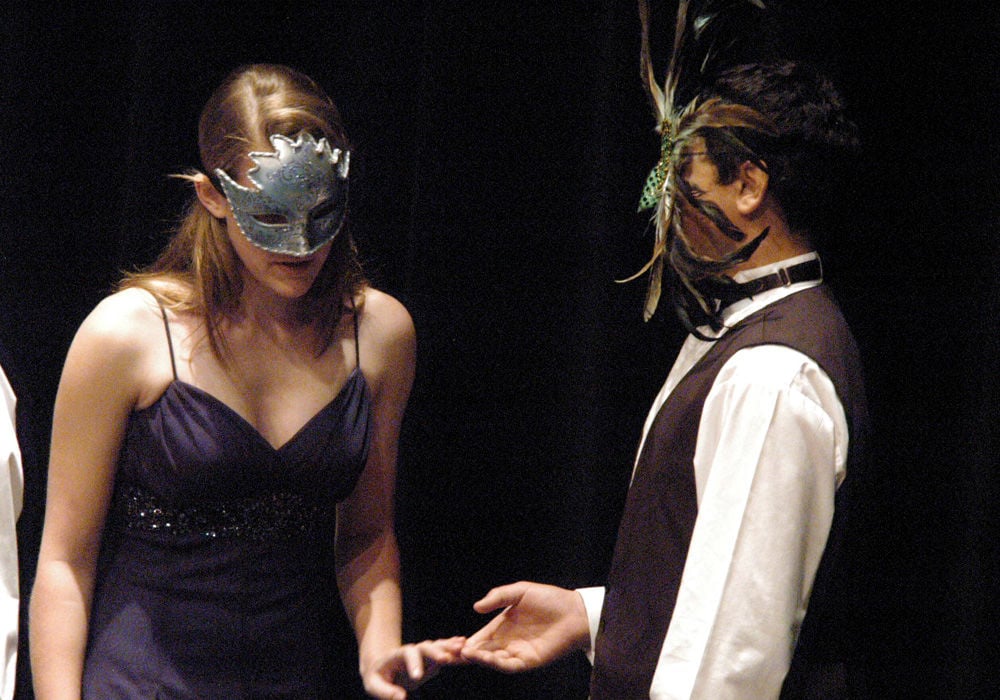
Romeo and Juliet(Students from Beall High School performing Romeo and Juliet during the 2007 festival, image taken from Cumberland Times News)

                William Shakespeare: Everyone knows William Shakespeare.  His works are read around the world – even in the far east, the cultured will recognize a Shakespeare reference.  Meanwhile, in the United States, it has become an educational staple, with most high schools featuring his works as required reading at some point.  Of course, not all such Shakespeare lessons are so mandatory: there has been a growing movement of “Shakespeare Festivals” in high schools across the country, where high school students are trained on how to read Shakespeare and perform scenes from these works.  While these have become fairly common, a small college town in Western Maryland has developed their own unique twist on the Shakespeare Festival.

                Created by Doctor Rochelle Smith, the Frostburg Shakespeare Festival has been an annual staple of the end-of-semester festivities for spring.  Every reading day (the day of study between the last day of classes and the first day of exams for Frostburg State University), a handful of college students and over two hundred high school students, their teachers, and often their families and friends gather at the Pealer Performing to watch the students perform their scenes and have fun with Shakespeare themed fun and games.  It is, as far as Dr. Smith knows, unique: this is the only Shakespeare Festival that teaches the high school students using the passion and expertise of interested college students trained in the subject matter.

                The FSU students are English or Drama students who have already passed one of Frostburg’s other high-level Shakespeare classes and are invited by Professor Smith.  The students go to join with high school students once a week, and together they work on a single scene from a play.  The scenes are chosen based on the class – some high school teachers might want to do Romeo and Juliet, for instance, but have a group consisting of all boys.  “Obviously, they aren’t going to do one of the love scenes,” Doctor Smith comments.  “They’re going to do a fight scene.” 

The groups read through the scenes, not just for the language but to figure out all the deeper meaning they’ll need to perform the scene effectively: What are the character’s motivations?  What are they really saying behind this over the top prose?  Why are they doing what they are doing?  These are all questions that need to be answered to perform the scene. 

                Once the scenes are understood, the classes move on to learning to perform it.  The college students teach the high schoolers how to stage a scene effectively, how to block properly, and advise on inflecting and projecting.  They also get appropriate set dressings, props, and – if the scene calls for it – music. 

                Breanna Liddy, a college student in the class, comments on the experience overall: “I think it is definitely a challenge and takes a lot of patience, but it builds character.  It isn’t easy to jump into a high school class and try to explain Shakespeare, which is already a difficult read at first, but the more they learn the more it shows through their interpretations and the students are also able to take control of the stage and shine through.”

                Though the performances must keep the language of the play unchanged, they can change the scene to another setting that make sense.  It can’t just be some arbitrary setting, but the students have had some creative choices come up.  Retelling Macbeth as the tale of a Mafia boss’s rise to power is a cool retelling.  Romeo and Juliet has plenty of variations, usually boiling down to which factions are being used to replace the Montagues and the Capulets:  one class utilized the common high school scene of jocks versus geeks, but one of the seemingly most popular versions had the two families flying the flags of Fort Hill and Allegany High – the two rival high schools in the area.

                The excitement is high on the day of the festival itself.  The high school students get shown around the Frostburg campus, and even get to eat at the Chesapeake dining hall.  “My students always think its strange how much the high schoolers love our dining hall,” Dr. Smith comments, “but that’s just because they’ve forgotten how bad high school cafeterias were!”

                Eventually the crowd packs into the theater to watch everyone’s performances.  Each group brings their own props, interpretations, and creativity to the scenes, so even if two groups are performing the same scene, the end results can be wildly different.  This is an especially fun for the festival commentators like the retired professor Mary Ann Chapman, who have the job of watching the performances, looking for what creativity and understanding they brought about in their performance, and saying “I see what you were doing!”

                “The ones I’ve enjoyed the most are the ones that show both creativity and humor” Chapman comments – though, she adds, “it helps that some of the students are really good actors.”  It can be a proud moment for her as well, as some of the high school teachers were, in fact, her own students, and she gets to see her student’s students performing.

                Dr. Smith adds “I’m always so amazed at how creative the students are, and I’m amazed at the understanding they show of the scene.”

                The performances are punctuated with Shakespeare related fun and games, including a Shakespeare quizbowl and games like “how much like Hamlet are you?” – you can always tell which students have been reading Shakespeare on their own when they can answer questions that weren’t in the required readings.  The whole event is usually finished off with a visit from the Savage Mountain Stage Combat Club, who detail the sorts of weapons used in Shakespeare’s plays, as well as perform a few fight scenes. 

                The festival has been so successful its astonishing to think that the catalyst for it all was, in fact, an accident, when the Folger Shakespeare Library in Washington, D.C., mistakenly sent Dr. Smith an invitation email to their local high school festival.  Dr. Smith decided to check it out anyway, and ended up thinking “Wow, we could do that here!” 

For Frostburg students, the festival not only provides an excellent opportunity for learning but also is a great learning experience and resume addition.  However, the effect it has on high school students might be even better: “It’s a very good recruiting program” Dr. Smith explains.  The high schoolers are always have a great time visiting our campus, and in the classes they get to meet and work with some of Frostburg’s best students.  She does admit, it is a bit intimidating being responsible for over 200 highschool students when they come up to visit, but they’ve always been well behaved.  “We haven’t had any disasters yet!”

The Frostburg Shakespeare Festival is funded by the Frostburg State University Foundation Opportunity Grant and by the Presidential Experiential Learning Enhancement Program.


Doctor Rochel Smith:
Rochelle Smith


Friday, May 4, 2018

The Calming Gentle Giants – Manatee Park in Lee County, Florida


The Calming Gentle Giants – Manatee Park in Lee County, Florida
           
            What kind of impact do you expect animals to have on humans? Manatee Park exemplifies the power that animals have to people. During the beginning of December 2017 to the beginning of March in 2018, there were over 200,000 visitors to the Park. The people came in from all across the country, and even the globe. The demographics of people were rich in diversity by having every walk of life come through the Park. From toddlers to the elderly, people were enthralled by the exciting moment of getting to see the protected animal, the manatee, live in action. My mother lives in Fort Myers, Florida, so the Park was very close to our general vicinity.
This is the waterway where the manatees gather during the winter months in Florida.
 At first, I was apprehensive to go the Park and be surrounded by children and parents of the like. However, surprisingly there were not only more than just kids at the Park, but there was so much more to the Park than just seeing the manatees. There are educational programs to learn about the local wildlife, the history of the Park, and immense amounts of information about the manatees themselves. In short, the consensus amongst everyone that I have talked to working and casually visiting the Park spoke of the same three words describing the manatees with being “calming gentle giants.” When I began to see the wholesomeness of the Park itself is when I knew I was stumbling on something special.
            After my first visit, I began to go to the Park every time I was able to visit my mother. Due to the vast amount of people that come through the Park, I became interested in the kinds of people that entered the Park and their reasons for coming. I devised a plan of people to talk to, which goes as follows: meet with a photographer, a maintenance employee, a random pedestrian, an employee of the Park, and a higher up in the Park’s staff. The purpose of the eclectic group chosen is to get as broad of a perspective as possible to understand why the people attend the Park.
A photographer is important choices to make because he/she is a professional in capturing life’s beauty, so a reason as to why they would be attending the Park instead of other places that have just as beautiful sights to see. A maintenance employee would be a great choice for someone to interview because of their experience being at the Park. Due to working at the Park for an extended period of time, the employee would be able to gauge the kinds of people that come in and the potential character that people entering have. A random pedestrian is crucial to eliciting the type of person that comes in since the pedestrians are making up for more than half of the prescribed character of the people that enter the Park. More general questions can be asked since the more focused-based questions geared towards the employees would be less relevant. An employee of the Park, some that are not a maintenance worker, typically a gift shop employee or traffic director would make for a successful interview because they are well versed in the people that come into the Park, but on a more interpersonal level due to the interaction with visitors that is required through their job. The last person to interview is the more empirical side of the report where I ask them why their professional opinion as to why people enter the Park, and through their years of supervisory works, why is the Park special?
The Southern Live Oak! Below has more information on
this beautiful tree. (Much better in person.)
            The photographer interview was named Nick Knickerbocker, who specialized in flying drones in the use of photography. Nick was a charismatic person who has continuously come to the Park in order to get shots of the beauty of the Park itself and to capture beautiful shots of manatees. Nick has been a photographer for several years and has always admired the little details of life. During my interview with Mr. Knickerbocker, he was telling about what it means to be a photographer. “My life revolving around seeing things that other peoples don’t,” he exclaims. His work ties into his own philosophies of life and photography because he is able to capture a perspective that many people cannot experience. The genuine experience that was created allowed me to add to the case that the Park brings out the positive, lighter side in people.

       The maintenance employee, Rick Highland, was the soil of the Park. Rick is a down to earth person that seemed to be in good spirits despite what many people would consider unfavorable work. When asked what is unique about him as a person, he surprisingly replied, “I love my job.” Being able to help something bigger and outside of himself is something that I would say is one of the most important things in life. Rick was riding in a maintenance cart that was happily going around the Park doing the yard work. He told me that he would make more money working at other bigger parks, but Rick chooses to work at Manatee Park because of his love for his Park. Taking less money to work at the Park speaks volumes about the nature of the Park itself, as well as the community’s nature of being pleasant to work with.
            The random person that I interviewed, a commoner to the Park, was named Bill Cobb. Bill talked my ear off a bit, but I enjoyed the interaction with him. He was telling me all about himself and how he used to be a train engineer. Bill told me about his son who was a National Coast Guard and the reason he was at Manatee Park was to do something with his family. Since his son is frequently out of state, Bill views Manatee Park as an opportunity to spend time with his family. Due to the limited time that Bill has with his son, I believe that speaks highly of the Park since he chose to spend his time there. When I asked why he believes that the Park is important, Bill shared “The Park gives life to animals that need it…and allows people to appreciate it their own more.” With great sincerity, Mr. Cobb explains the view that the feeling of the park draws people in with, and that is the feeling of wholesomeness.
            When I was looking for a person to find, I thought about buying a souvenir in the Park’s gift shop. I began talking with the employee working at the store named Yvonne. Yvonne was an expert in traveling; she told me that she has been to over a hundred countries across the globe, and ultimately, ended up choosing to spend most of her time working at Manatee Park. She explains that the relations with the volunteers, the civilians, fellow members of staff, and the fact that she is able to work and benefit nature are nothing but a positive experience. The importance that Yvonne displaces on being able to not only help wildlife but have meaningful and pleasant interactions with other people tells me that the park is a hub for creating relationships with positive influences outside of one’s self. Yvonne’s testimony of the park gave me eyes an even brighter perspective on the park since out of all of the beautiful places in the world to live, she ended chooses an area near a fairly small, innocent park.
            The final person I spoke with was a phone call with Laura Carr, who is one the Senior Program Specialists of the park. Her duty is, as she told me, a jack of trades. Basically, it is better to question what she doesn’t do for the park. Since Laura told me that she had been working with wildlife for nearly 18 years, I asked why she felt that Manatee Park was special enough to warrant her time and experience. She passionately replied by stating, “My favorite part of the job is working with the dedicated volunteers that make her life easier and fun with people coming to the park that she is able to educate and see their eyes light up with excitement.” Due to Laura having a rich background in wildlife ecology and environmental conversation, her skillset about chooses these gentle giants, more specifically working at the park, exemplifies how special the park is to so many people.
Facts about manatees and their nearest relatives.
            Manatee Park is an adjunct for those looking for a universal feeling of appreciating the world around you. Nothing compares, for those attending the park than being in nature and being surrounded by something bigger than one’s self. Every time they tell stories about people spotting manatees, only the essence of pure kid-ish excitement captures what it truly means to visit Manatee Park.


 Three websites to learn more about Manatee Park:

o   www.MyFWC.com This is good to a website to use because it gives the user information about the manatees as an organism, and after research, one could find a reason as to why manatees are special. The FWC stands for Fish and Wildlife Conversation Commission.
o   http://www.leegov.com/parks/facility?fid=0088 This is the government website that gives the user everything they would need to know about the Lee County Manatee Park on a surface level.

o   https://www.facebook.com/ManateePark The Facebook profile would be fantastic to account for the kinds of people entering the park. The responses to the posts would be a great highlighter for the people that care about Manatee Park.

This a drone shot that I pulled from the web to show what it looks like when Manatees are present during the winter months.
Link to Source